
Your back and hamstrings may have plenty left to give, yet your fingers open before the set is over. Learning how to use lifting straps can help you keep the target muscles working when grip is the limiting factor – without turning straps into a shortcut for every pull.
Lifting straps attach your hands more securely to a barbell, dumbbell, or cable handle. Used well, they can help you train heavier or perform more quality reps on deadlifts, rows, Romanian deadlifts, shrugs, and high-rep pulling work. Used too early or wrapped carelessly, they can hide a weak grip and make it harder to release the weight safely.
Straps are most useful when your training goal is to challenge a large pulling muscle group and your grip gives out first. For example, a lifter doing Romanian deadlifts for hamstring growth may have the hip strength for 10 reps but lose the bar at rep seven. Straps can let that set reach its intended muscular target.
They are also valuable for heavy rows, shrugs, rack pulls, and demanding back sessions where forearm fatigue builds quickly. Straps allow many lifters to use a secure double-overhand grip rather than relying on a mixed grip for every heavy deadlift set. That may feel more balanced and can reduce the temptation to jerk the bar off the floor.
The trade-off is simple: straps reduce how much your hands must work to hold the load. Keep some unstrapped work in your program if grip strength matters for your sport, job, climbing, martial arts, or overall lifting development. Warm-up sets, lighter sets, loaded carries, hangs, and dedicated grip exercises are all useful places to train your hands without assistance.
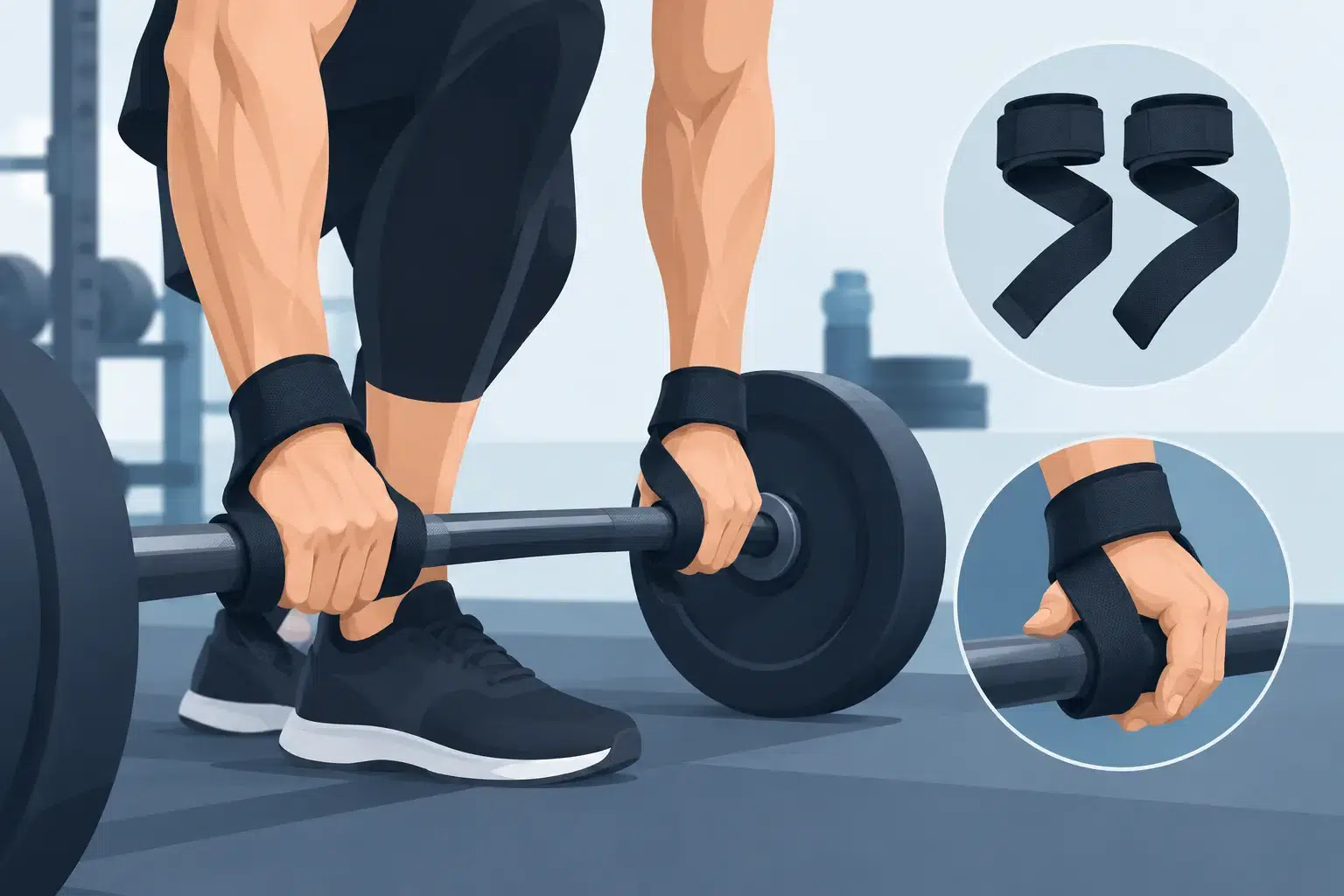
Most gym straps are lasso-style straps: one end has a loop and the long tail wraps around the bar. The key is to wrap the strap in the same direction the bar would roll out of your fingers. When you pull against the weight, the strap should tighten around the bar, not unwind.
Feed the long tail through the sewn loop to create a cuff, then slide your hand through it. Position the cuff high on your wrist, just below the base of your palm. It should feel snug but should not restrict circulation or cause numbness.
The tail should lie across the palm-side of your hand, ready to reach the bar. Set up both straps before approaching a heavy lift. This saves time and helps you keep your focus once the set begins.
Grip the bar with an overhand grip before wrapping the straps. Start with your hands roughly where they would normally sit for the lift. For a conventional deadlift, that is usually just outside your legs. For rows, use the grip width that lets you pull with control and keep your shoulders comfortable.
Do not try to create a strap-only hold. Your fingers and thumb should still close around the bar. The strap supports your grip; it does not replace it.
Pass the tail under the bar, then wind it around the bar two or three times. Keep each wrap flat and tight. With the final section of strap against the bar, close your hand firmly over it.
A quick check tells you whether the direction is right: gently pull up on the bar to create tension. The strap should cinch down. If it loosens or rolls open, unwrap it and reverse the direction before lifting.
Set your hands, pull the slack out of the straps, and brace as you normally would. For a deadlift or Romanian deadlift, keep the bar close to your body and build tension before moving it. For rows, avoid yanking the weight just because the straps make it easier to hold.
Straps can improve your connection to the load, but they cannot correct poor position. A neutral, controlled torso, stable shoulders, and a repeatable bar path still matter more than the accessory on your wrists.
At the end of the set, lower the weight under control and let it settle fully. Open your fingers, unwind the straps, and step away. Avoid dropping a bar while your hands are still tightly bound to it.
This is one reason lasso straps are better suited to controlled strength and hypertrophy work than lifts that require a fast release. If you are new to straps, practice wrapping and unwrapping with an empty bar or a light working weight first.
Lifting straps are especially effective for Romanian deadlifts, stiff-leg deadlifts, barbell and dumbbell rows, shrugs, pulldowns, and heavy rack pulls. On these exercises, the goal is often more time under tension for the back, traps, glutes, or hamstrings. A secure grip can help you reach that goal without ending the set because of tired fingers.
For conventional deadlifts, straps are a useful option for volume work, higher-rep sets, or bodybuilding-focused training. Powerlifters, however, should regularly practice without straps if their competition requires a raw grip. The best approach depends on the purpose of the session.
Use caution with Olympic lifting variations, kettlebell work, and any exercise where you may need to release the handle quickly. Traditional straps can make bailing out awkward. Figure-eight straps are very secure for heavy deadlifts, but that same security makes them less forgiving for movements where an easy exit matters.
The most common error is wrapping too loosely. Loose straps shift, create pressure points, and force you to re-grip mid-set. Wrap them firmly, but do not overtighten the wrist cuff.
Another mistake is using straps on every warm-up and every easy set. Begin bare-handed whenever practical, then add straps once the load, rep range, or accumulated fatigue makes grip the true limit. This gives you the performance benefit while keeping regular exposure to unassisted holding strength.
Some lifters also let straps encourage poor technique. If your lower back rounds sharply during a deadlift, your shoulders lose position on rows, or you are using momentum to move the load, reducing the weight is the better answer. Straps should support good training, not make risky reps possible.
Finally, avoid treating wrist pain as a strap problem. Straps can feel different depending on the material and cuff width, but persistent pain, tingling, or numbness calls for stopping the exercise and assessing your setup, load, and recovery.
Cotton lasso straps are a strong all-around choice for most gym-goers. They are affordable, easy to adjust, and suitable for rows, pulldowns, deadlifts, and shrugs. Leather straps tend to be more durable and may feel firmer against the wrist, while padded straps can improve comfort for some lifters but add bulk.
Figure-eight straps are built for maximum holding power on heavy pulls. They are popular with strongman athletes and advanced deadlifters, though they take more practice to set up and are not the best first pair for general gym training. If you want one versatile option, start with a standard lasso strap and learn to wrap it neatly.
Good Life Nutrition House offers practical training accessories alongside performance nutrition, making it easier to match your straps, recovery habits, and workout support to the way you train. Choose gear that fits securely, inspect it for fraying, and replace worn straps before they fail under load.
A good strap setup should feel almost unremarkable: your hands stay connected to the bar, your attention stays on the muscles you are training, and every rep remains controlled. Use them strategically, keep building your natural grip, and let your training goal decide when the extra support earns its place.